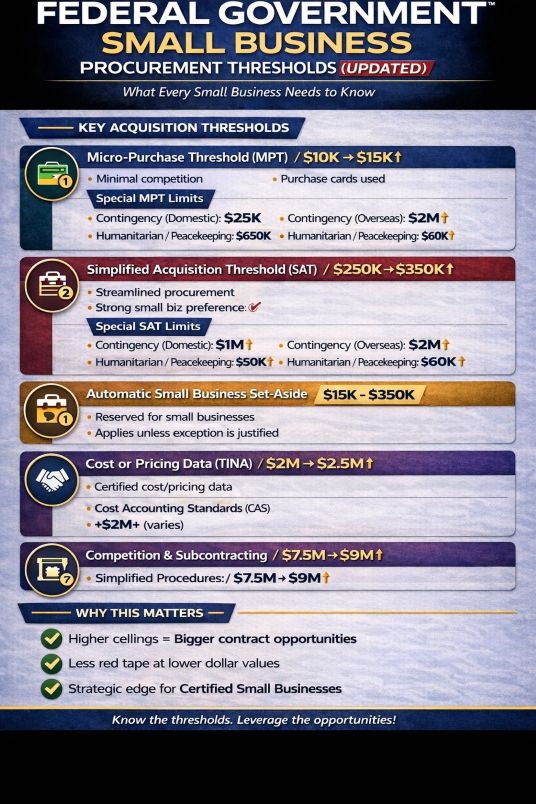
Federal Thresholds: Greater Opportunity, Greater Challenges
While the new Federal Government Small Business procurement threshold increases are intended to expand opportunity, they may also create unintended adverse effects for portions of the small business community. As thresholds rise, agencies gain greater flexibility to make larger awards using streamlined or limited‑competition procedures. This can disadvantage very small and emerging firms that lack established relationships, past performance, or visibility with contracting officers, as agencies may repeatedly rely on known vendors rather than opening requirements to broader competition. In practice, fewer openly competed solicitations can reduce transparency and limit access for newer small businesses trying to break into the federal marketplace.
Additionally, higher thresholds can intensify competition within the small business category itself. As larger, more experienced small businesses are able to pursue higher‑value contracts under simplified rules, micro and lower‑revenue firms may be crowded out. These firms often lack the infrastructure, staffing, or cash flow needed to perform larger awards, even when technically eligible. Over time, this dynamic can contribute to market consolidation among “upper‑tier” small businesses, slowing the growth of truly small or disadvantaged firms and undermining the intent of federal small business programs to broaden participation and promote equitable access across the entire small business ecosystem.